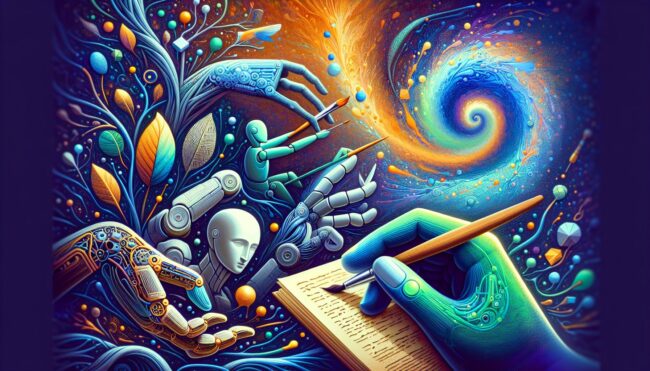
Hey tech enthusiasts! Today I want to talk about something that’s been blowing my mind lately—AI breaking into the creative arts. As someone who’s watched AI evolve from basic algorithms to the crazy-powerful tools we have now, I’m honestly fascinated by how it’s becoming part of human creativity. Let’s dig into this weird and wonderful space where technology meets art, and why I think this AI creative boom is worth getting excited about.
A Brush with the Algorithm: AI in Visual Arts
Let’s start with visual arts—and wow, has AI come a long way. Remember when computers could barely manage a decent pixelated smiley face? Yeah, we’ve definitely moved past that.
Modern AI algorithms, like GANs (Generative Adversarial Networks), are creating artwork that’s not only beautiful but genuinely makes you think. These AI models work by having two neural networks basically compete with each other—a “generator” and a “discriminator”—to produce artwork that even experienced critics struggle to distinguish from human-made pieces.
What I love most? Artists can now team up with AI to break through their creative limits. Take artist Robbie Barrat, who mixes AI creations with his own work to make pieces that really challenge what traditional art can be. This partnership between human and machine is changing what it means to be an artist, mixing human intuition with machine precision.
Symphonies by Syntax: AI in Music Composition
Now let’s talk music, where AI is literally composing its own symphonies. And before you say music should stay purely human—hear me out. AI’s role here feels more like having an incredibly talented bandmate than a replacement.
AI tools like AIVA (Artificial Intelligence Virtual Artist) have created complex compositions and even gotten credits alongside human artists. These programs analyze thousands of musical pieces, learning patterns, timing, and how different notes create emotional impact. Then they craft melodies that actually connect with listeners and push musicians to try new things.
What really gets me excited is how AI composition shakes things up while still honoring musical tradition. Musicians working with AI are finding new sources of inspiration and experimenting with genre combinations they never would have tried before.
Prose and Poetry by Code: AI in Writing
Here’s where things get personal for me—writing. As someone who loves a good story, watching AI enter the world of prose and poetry is both exciting and, honestly, a little eerie sometimes.
AI models like OpenAI’s GPT series have been making waves for generating text that’s not just coherent but often surprisingly creative. These systems train on massive amounts of literature, picking up on language patterns, story structure, and even subtle writing techniques.
What I find most interesting is when writers use AI as a collaborator rather than competition. Sci-fi authors, for example, are using AI to brainstorm plot twists or build complex fictional worlds. It’s a cool partnership where the human writer stays in control while AI throws out creative ideas that can lead to unexpected story directions.
The Human Touch in Machine Creativity
I know what some of you are thinking: “Isn’t this the death of human creativity?” Absolutely not. AI entering the arts isn’t about replacing human artists—it’s about giving them new superpowers. This isn’t some robot takeover of the art world!
With AI handling some of the technical heavy lifting or offering fresh perspectives, artists have more space to focus on the uniquely human stuff—emotion, meaning, personal experience—that machines just can’t replicate. Instead of being competitors, AI and artists are becoming creative partners in something totally new.
Balancing Innovation with Ethics
But let’s be real—this isn’t all sunshine and digital rainbows. AI in creative arts brings up some serious ethical questions we need to tackle. Who owns AI-generated art? How do copyright laws work when a machine creates something? These are hot debates in both legal and creative circles right now.
Then there’s the bias problem. AI learns from existing data, so if that data has biases, the AI’s creative output will too. We need transparent development and careful attention to training data to make sure AI creativity represents diverse voices and perspectives.
The Future: A Creative Utopia?
Looking ahead, I think the future of AI in creative arts looks like this amazing collaboration between human and machine creativity. I’m betting we’ll see even more sophisticated tools that combine AI’s pattern recognition with deep human storytelling.
Picture AI helping new creators learn faster, or assisting TV writers when they hit creative blocks. The possibilities are as endless as human imagination—just turbocharged by machine intelligence.
So what do you think? Are we heading toward a creative world where algorithms become as essential as paintbrushes and guitars? My gut says we’re at the start of something really exciting. I can’t wait to see what amazing art comes out of this blend of human creativity and artificial intelligence.
Until next time, keep creating, and don’t be scared to let a little AI into your artistic process. Your next masterpiece might just be a team effort with our digital collaborators.