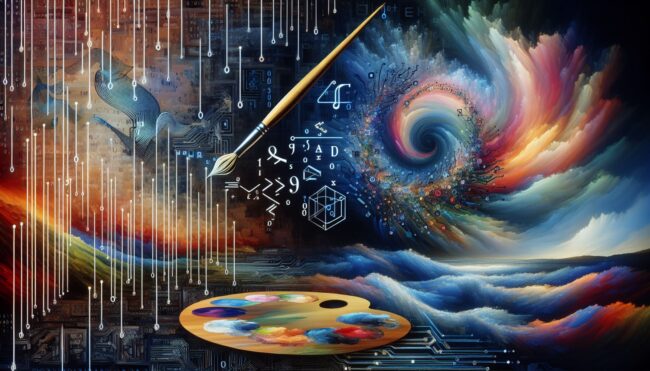
Hey, tech enthusiasts! Today, I’m jumping into a subject that’s been causing quite the buzz on the internet: Artificial Intelligence in Creative Arts. Yep, we’re watching a creativity revolution happen, folks, and it’s moving faster than you can say “deep learning.”
The Dawn of AI Artistry
Let’s face it: when we first heard about AI stepping into the realm of the arts, a lot of us were skeptical. I mean, aren’t creativity and emotion purely human? Well, as it turns out, the lines are blurring and it’s mind-blowing. From painting to composing music and even writing poetry, AI is breaking boundaries and exploring parts of creativity we never thought possible for a machine.
Take the case of DALL-E by OpenAI. This little genius can generate images from textual descriptions, connecting imagination with visual representation. Want a picture of a “cosmic flamingo drinking latte on the moon”? DALL-E’s got you covered. It’s like having a world-class artist on command, except this one works 24/7 and never demands coffee breaks.
Pixels to Masterpieces: The Tech Behind AI Art
What makes AI art tick, you ask? It’s basically a mix of neural networks, machine learning, and loads of data crunching. The key players in this field use Generative Adversarial Networks (GANs) to create jaw-droppingly realistic pieces. Introduced by Ian Goodfellow in 2014, GANs are all about pitting two neural networks against each other to produce original content.
Imagine giving an art student and a critic an infinite canvas and a whole library of art history to learn from. The GAN model has two nets, the generator (the art student) and the discriminator (the critic). Together, they work in tandem until the generator creates something indistinguishable from the real deal. And let me tell you, some of the results are so mind-bending they make you wonder if they’ve tapped into an alternate universe’s creativity pool.
AI Songs and Symphonies
It’s not just visual art getting a tech makeover. Music is also feeling the AI vibe. Meet Aiva, an AI composer who’s been writing original scores for film, games, and even symphonies. It’s like having Beethoven with a silicon brain. Interestingly, Aiva’s music isn’t soulless. Instead, it’s a weird fusion of mathematical precision and emotive resonance that both delights and intrigues.
Of course, some purists might grumble at the thought of machines taking over this most human of endeavors. But let’s remember, folks, when electric guitars first came out, the world was certain rock was dead. Spoiler alert: it only got louder and more electrifying.
AI’s Brush with Fame: Real-World Applications
You might be wondering, “Okay, but where’s the real-world impact?” Glad you asked. The applications are happening in exciting ways, both in the gallery and the entertainment industry.
In 2018, an AI-generated artwork titled “Edmond de Belamy” sold at a Christie’s auction for over $430,000, a clear sign that AI art isn’t just a tech novelty. It’s becoming a serious industry player. Plus, there’s the rise of AI in film. Walt Disney and other big studios are exploring ways AI can automate animation or improve visual effects, cutting down on tedious tasks and opening up a realm of new creative possibilities.
The Ethical Canvas: Challenges and Considerations
No discussion about AI in the creative arts would be complete without touching on the good ol’ debate about ethics. Who really owns an AI-created piece? The developer, the model, or the machine itself? This question makes my brain hurt, and probably yours too!
Then there’s the fear of job displacement. Could painters, musicians, and writers be out of a job? Well, history shows us that technology, while disruptive, often creates new roles and opportunities. Remember, there was panic when photography was invented, yet portrait painting still thrives, just in a different way.
A Bold Brushstroke into the Future
Looking forward, the potential is both staggering and exhilarating. We may very well be entering an era where human collaboration with AI leads to art forms we’ve yet to even imagine. Picture this: artists of tomorrow could be more like conductors, orchestrating an ensemble of AI networks to create multi-sensory experiences, each gesture and note a triumph of man and machine.
Could we see an AI-driven renaissance? The romantic in me likes to think so. But regardless, as the canvas of technology continues to expand, it’s clear one thing won’t change: our relentless pursuit of beauty and expression. In the end, what is art if not an exploration of the possibilities?
So, let’s cheers to a future where creativity crosses both human and algorithm lines, where a new kind of muse inspires us to innovate and dream bigger. I can’t wait to see (or hear) what comes next. How about you?
Keep imagining the impossible, folks, because in this tech-driven world, it just might not be.
Catch you on the flip side,
[Your Name]